


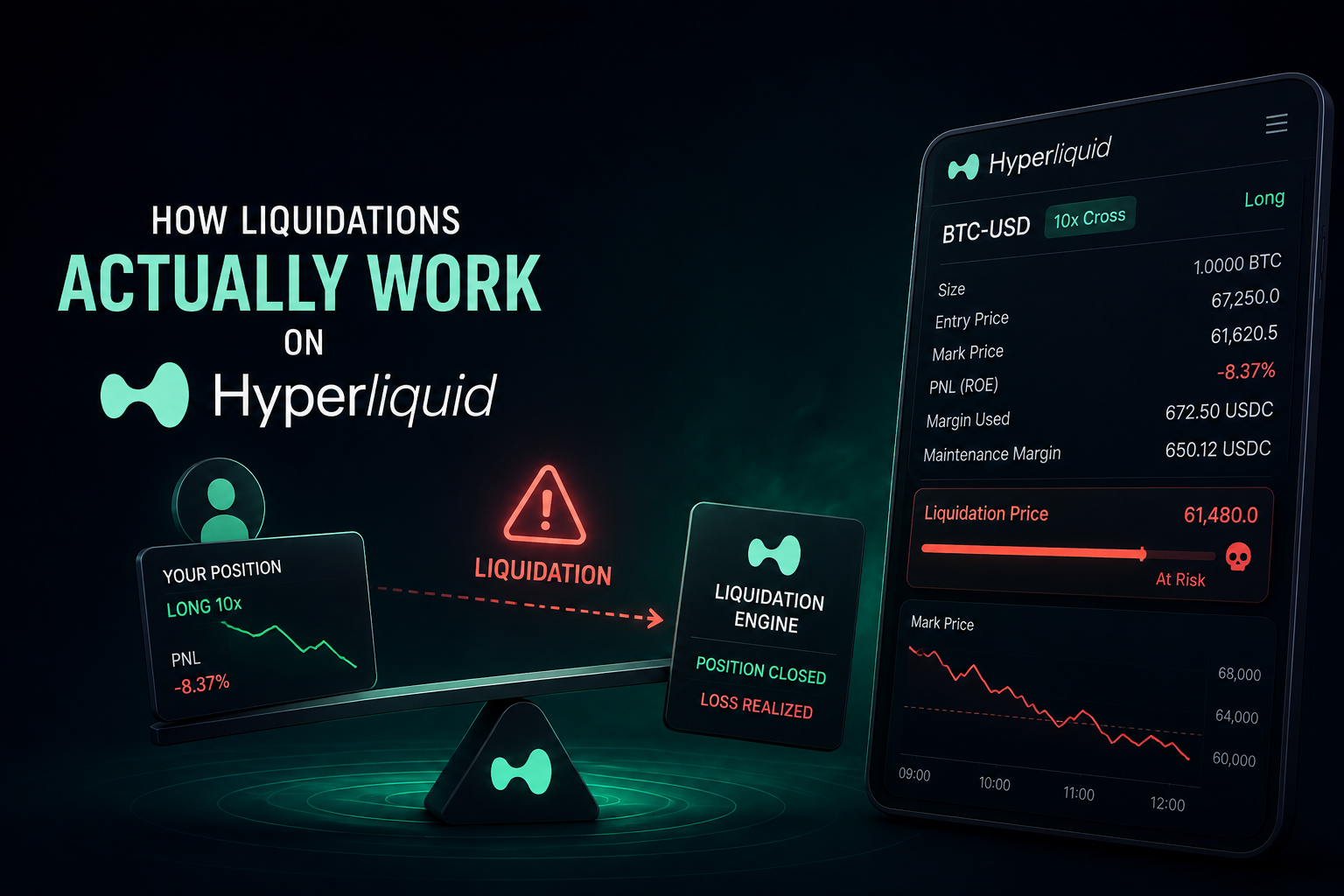
Hyperliquid liquidation begins when a trader’s account equity falls below the maintenance margin required for the position. The protocol first attempts to close the position through market orders on its order book; only if that process does not restore the required margin and the account falls below a deeper threshold does a backstop liquidation through the liquidator vault occur. The exact outcome depends on the margin mode, position size, margin tier, funding, mark price, and the state of the book at the time.
Note: This article explains protocol mechanics documented by Hyperliquid. It is not a recommendation to use leverage or a prediction of liquidation prices. Parameters can change, so traders should consult the live official liquidation documentation before trading.
What is the short version of Hyperliquid liquidations?
A position becomes liquidatable when the relevant account equity is below maintenance margin. Hyperliquid normally sends liquidation orders to the book first, while a liquidator-vault backstop is used when equity falls below two-thirds of maintenance margin and book liquidation has not successfully resolved the deficit.
- Liquidation trigger: equity below the applicable maintenance-margin requirement.
- Price reference: the mark price, not simply the latest trade or an instantaneous book price.
- First response: market liquidation orders are sent to the order book.
- Backstop response: positions can be transferred to the liquidator vault when the account falls below the documented two-thirds threshold.
- Key distinction: ordinary book liquidation may leave remaining collateral with the trader; backstop liquidation does not return maintenance margin.
How does the Hyperliquid liquidation sequence work?
The process is staged: monitor maintenance margin, attempt book execution, and use the liquidator vault only when the deeper backstop condition is reached.
Think about it this way: the protocol does not treat every liquidation as an immediate transfer of the entire account. It first tries to reduce or close the position through the market. If the position is fully or partially closed and the remaining account satisfies its maintenance-margin requirement, any remaining collateral stays with the trader.
- Equity falls below maintenance margin. The position enters the liquidation process.
- Market orders go to the order book. The order is intended for the full position size, but it may fill fully or partially.
- Margin is reassessed. If the filled amount restores the required maintenance margin, the process can stop and remaining collateral remains with the trader.
- Backstop threshold is reached. If liquidation through the book has not succeeded and account equity falls below two-thirds of maintenance margin, the liquidator vault can take over under the documented backstop process.
Visual process map:
| Stage | Condition | Protocol action | Possible account result |
|---|---|---|---|
| 1. Healthy margin | Equity meets maintenance requirement | No liquidation action | Position remains open |
| 2. Liquidatable | Equity falls below maintenance margin | Market liquidation order is sent to the book | Position may be reduced or closed |
| 3. Resolved on the book | Filled liquidation restores required margin | Book liquidation stops | Remaining collateral stays with the trader |
| 4. Backstop | Book liquidation has not resolved the deficit and equity is below two-thirds of maintenance margin | Liquidator vault may take over | Outcome depends on cross or isolated margin mode |
Key insight: “Liquidatable” does not automatically mean that the entire position or account is transferred to the backstop. Hyperliquid documents an intermediate order-book liquidation stage.
Why does Hyperliquid use the mark price for liquidation?
Hyperliquid uses a mark price that combines external centralized-exchange prices with the state of its own book, making the liquidation reference more robust than a single instantaneous book price.
The mark price can differ materially from the book price during high volatility or when a position is highly leveraged. That difference means a displayed liquidation level should not be interpreted as a promise that liquidation will occur at a particular last-traded price.
- The mark price is the protocol’s liquidation reference.
- Book price and mark price can diverge, especially in stressed or illiquid conditions.
- Hyperliquid recommends using the exact documented formula for precise monitoring.
What is the difference between cross and isolated liquidation?
Cross margin shares collateral among cross-margin positions, while isolated margin constrains collateral to a specific asset position. As a result, the scope of a backstop liquidation differs substantially between the two modes.
| Feature | Cross margin | Isolated margin |
|---|---|---|
| Collateral scope | Shared among cross-margin positions | Constrained to the selected asset position |
| Effect of liquidation in another isolated position | Other isolated positions are separate | Other isolated and cross positions are not affected by that isolated liquidation |
| Backstop transfer | Cross positions and cross margin are transferred to the liquidator | The isolated position and isolated margin are transferred |
| Other collateral | If there are no isolated positions, the trader ends with zero account equity after the documented cross backstop transfer | Cross margin and cross positions remain untouched |
| Liquidation price sensitivity | Not determined by the leverage setting alone; lower selected leverage generally uses more collateral | Depends on the isolated margin allocated, which is tied to the initial-margin setting |
The margin-mode definitions and separation rules are described in Hyperliquid’s official margining documentation. Some assets are documented as strict isolated; for those assets, margin cannot be removed and is proportionally removed as the position is closed.
What happens in a large-position partial liquidation?
For a liquidatable position larger than 100,000 USDC on mainnet, Hyperliquid documents an initial market liquidation order for 20% of the position rather than the entire position.
After a block in which one of a user’s positions is partially liquidated, a 30-second cooldown applies. During that cooldown, the user’s market liquidation orders are for the entire position. The official documentation gives a 10,000 USDC threshold on testnet for easier testing; that testnet parameter should not be treated as the mainnet threshold.
Warning: The 100,000 USDC threshold, 20% initial order, and 30-second cooldown are documented protocol parameters. They are not universal rules for every venue and may be revised in future documentation updates.
How are maintenance margin and margin tiers calculated?
Hyperliquid calculates maintenance margin from notional position value, a tier-specific maintenance-margin rate, and a tier-specific maintenance deduction.
The official tier formula is:
maintenance_margin = notional_position_value × maintenance_margin_rate − maintenance_deduction
The maintenance rate is defined as half of the initial-margin rate at the maximum leverage for the relevant tier. Hyperliquid’s documentation gives a 20x maximum-leverage example with a 2.5% maintenance-margin rate. The maintenance deduction accounts for the rates used in earlier tiers so that total maintenance margin changes continuously as position size increases.
| Term | Meaning in the documented model | Why it matters |
|---|---|---|
| Notional position value | The value used to size the position for margin purposes | Larger positions can move into different margin tiers |
| Maintenance-margin rate | Tier-specific rate derived from the maximum-leverage initial-margin rate | Determines the required minimum equity |
| Maintenance deduction | Tier-specific adjustment for previous tiers | Keeps the total maintenance requirement continuous across tiers |
| Margin tier | A position-size tier with its own maximum leverage and maintenance parameters | Can change the liquidation calculation as position value changes |
Because margin tiers can change the maintenance requirement, readers should not assume that a simple percentage applied to the whole position will always reproduce the live liquidation price. The current tier data is documented in Hyperliquid’s margin tiers documentation.
Why can the displayed liquidation price differ from the actual liquidation price?
The pre-trade liquidation estimate can be inaccurate because book liquidity can change, and the post-entry estimate can still change because of funding payments, other cross-position unrealized PnL, and margin-tier effects.
- Before entry: the estimate may not reflect later changes in book liquidity.
- After entry: the displayed price has the certainty of the entry price but may still differ from the actual liquidation price.
- Cross margin: funding and unrealized PnL from other positions can change available margin.
- Mark price: liquidation is evaluated against the mark price, which may differ from book price.
- Position size: the applicable margin tier can depend on the position value at the liquidation price.
What is the documented liquidation-price formula?
Hyperliquid documents a formula that combines the entry price, side, available margin, position size, and maintenance leverage. It is a monitoring formula, not a substitute for the live protocol state.
liq_price = price − side × margin_available ÷ position_size ÷ (1 − l × side)
In the documentation, l = 1 ÷ MAINTENANCE_LEVERAGE, side = 1 for a long and side = −1 for a short. For cross margin, margin_available = account_value − maintenance_margin_required. For isolated margin, margin_available = isolated_margin − maintenance_margin_required. With margin tiers, maintenance leverage depends on the applicable tier at the position value used in the liquidation calculation.
What is the difference between book liquidation, backstop liquidation, and auto-deleveraging?
These are separate stages or mechanisms: book liquidation attempts to close positions in the order book, backstop liquidation transfers eligible positions to the liquidator vault, and auto-deleveraging is a final solvency safeguard when an account or isolated position becomes negative.
| Mechanism | Trigger described by Hyperliquid | What happens |
|---|---|---|
| Book liquidation | Equity is below maintenance margin | Market liquidation orders are sent to the book; fills may be partial or complete |
| Backstop liquidation | Book liquidation has not succeeded and equity is below two-thirds of maintenance margin | The liquidator vault can take over the relevant cross or isolated position and margin |
| Auto-deleveraging | Account value or isolated position value becomes negative | Opposite-side users are ranked and selected positions are closed at the previous mark price to prevent bad debt |
Hyperliquid describes the liquidator vault as a component strategy of HLP and states that liquidation PnL flows to the community through HLP. It separately describes auto-deleveraging as a final safeguard for platform solvency. ADL should therefore not be presented as the ordinary first step of a liquidation.
What can traders do to reduce liquidation risk?
The official liquidation documentation specifically identifies exiting a position or placing a stop-loss order before the mark price reaches the liquidation price as ways to avoid losing the maintenance margin in a backstop liquidation.
From a risk-control perspective, the mechanics imply several practical checks. A trader should understand whether the position is cross or isolated, monitor the mark price rather than relying only on the book price, account for funding and other cross-position PnL, and treat the displayed liquidation price as an estimate that can change.
- Use position sizing that leaves a meaningful margin buffer instead of treating maximum leverage as a target.
- Review the position’s margin mode and understand which collateral can be affected.
- Monitor the mark price and the position’s current maintenance requirement.
- Account for funding payments and the effect of other cross-margin positions.
- Consider a stop-loss or an earlier exit if the objective is to avoid a backstop transfer.
Risk reminder: A stop-loss is an order-management tool, not a guarantee of execution at a particular price. Market conditions, liquidity, and the mark price can affect outcomes.
What are the most important takeaways?
Hyperliquid liquidations are margin-based and mark-price-based, with an order-book stage before the liquidator-vault backstop. The most important distinctions are margin mode, position-size tier, and the difference between book liquidation, backstop liquidation, and ADL.
- Maintenance margin is the threshold that starts the liquidation process.
- Book liquidation is attempted before backstop liquidation.
- Cross and isolated positions have different collateral boundaries and backstop consequences.
- Large liquidatable positions can be subject to the documented 20% initial partial-liquidation rule and cooldown.
- Mark price, funding, other cross-position PnL, liquidity, and margin tiers can affect the actual liquidation level.
- Auto-deleveraging is a separate final solvency mechanism, not the normal first response.
Where can I verify the current liquidation rules?
The safest place to verify current parameters is Hyperliquid’s own documentation, because thresholds, margin tables, and implementation details can change.
Read the official pages for liquidations, margining, margin tiers, and auto-deleveraging. These links are the source basis for the explanations and parameters in this article.
Frequently Asked Questions (FAQs)
Q: Does Hyperliquid liquidate a position as soon as its displayed liquidation price is reached?
A: The protocol uses mark price and account maintenance requirements, not merely a displayed estimate. The displayed price can differ from the actual liquidation price because of funding, other cross-position PnL, changing liquidity, and margin tiers.
Q: Does a normal liquidation always take the trader’s entire account?
A: No. Hyperliquid first attempts market liquidation through the book, and if the required margin is restored, remaining collateral stays with the trader. The scope of a backstop transfer depends on cross or isolated margin mode.
Q: What happens to an isolated position during a cross backstop liquidation?
A: According to the official documentation, an isolated position is not affected by a cross backstop liquidation. The cross positions and cross margin are the assets transferred in the cross backstop process.
Q: What is the 100,000 USDC partial-liquidation rule?
A: For a liquidatable position larger than 100,000 USDC on mainnet, the documented initial market liquidation order is for 20% of the position. A 30-second cooldown follows a block with a partial liquidation, during which market liquidation orders for that user are for the entire position.
Q: Is auto-deleveraging the same as liquidation?
A: No. Auto-deleveraging is a separate final solvency safeguard used when an account value or isolated position value becomes negative. Opposite-side users can be ranked and selected positions closed at the previous mark price.
Q: Is this article financial advice?
A: No. It is an explanation of documented protocol mechanics. Leverage trading can result in rapid losses, and readers should verify live rules and assess their own circumstances independently.
Disclaimer: This guide is just made for informational purposes and not a financial advice. Do your own research before investing in crypto market because prices are volatile and do not invest money that you cannot afford to lose.