


Summary
- Base perpetual fee: 0.045% for a taker order and 0.015% for a maker order.
- Base spot fee: 0.070% for a taker order and 0.040% for a maker order.
- Tiering: Hyperliquid uses rolling 14-day weighted volume; spot volume counts twice toward the tier calculation.
- Discounts: HYPE staking can reduce trading fees by 5% to 40%, and a referral code gives 4% off a referred user’s first $25 million of volume.
- Funding: Perpetual funding is paid from one side of a contract to the other. Hyperliquid’s documentation says no protocol fee is collected on funding payments.
What are Hyperliquid’s base trading fees?
At the base tier, Hyperliquid charges 0.045% on perpetual taker trades, 0.015% on perpetual maker trades, 0.070% on spot taker trades and 0.040% on spot maker trades.
These are execution fees. The rate is applied to the notional value of the trade, not simply to the margin posted. A $10,000 perpetual position therefore costs $4.50 at the base taker rate or $1.50 at the base maker rate for one executed side, before any applicable discount or rebate.
- 0.045%Base perpetual taker
- 0.015%Base perpetual maker
- 0.070%Base spot taker
- 0.040%Base spot maker
Key insight: “Maker” and “taker” describe how an order interacts with the order book. A resting order that adds liquidity is generally a maker order; an order that immediately matches available liquidity is a taker order. The exact result depends on execution, so do not assume that choosing “limit” automatically guarantees maker treatment.
How do Hyperliquid perpetual and spot fees compare?
Base spot rates are higher than base perpetual rates, while both products use the same account-wide tier determined by weighted 14-day volume.
| Product | Base taker | Base maker | Example on $10,000 |
|---|---|---|---|
| Perpetuals | 0.045% | 0.015% | $4.50 taker / $1.50 maker |
| Spot | 0.070% | 0.040% | $7.00 taker / $4.00 maker |
Hyperliquid’s official documentation states that perps and spot volume are combined to determine the fee tier. The weighted-volume formula is:
This means $1 of eligible spot volume contributes $2 to the tier calculation, while $1 of perpetual volume contributes $1.
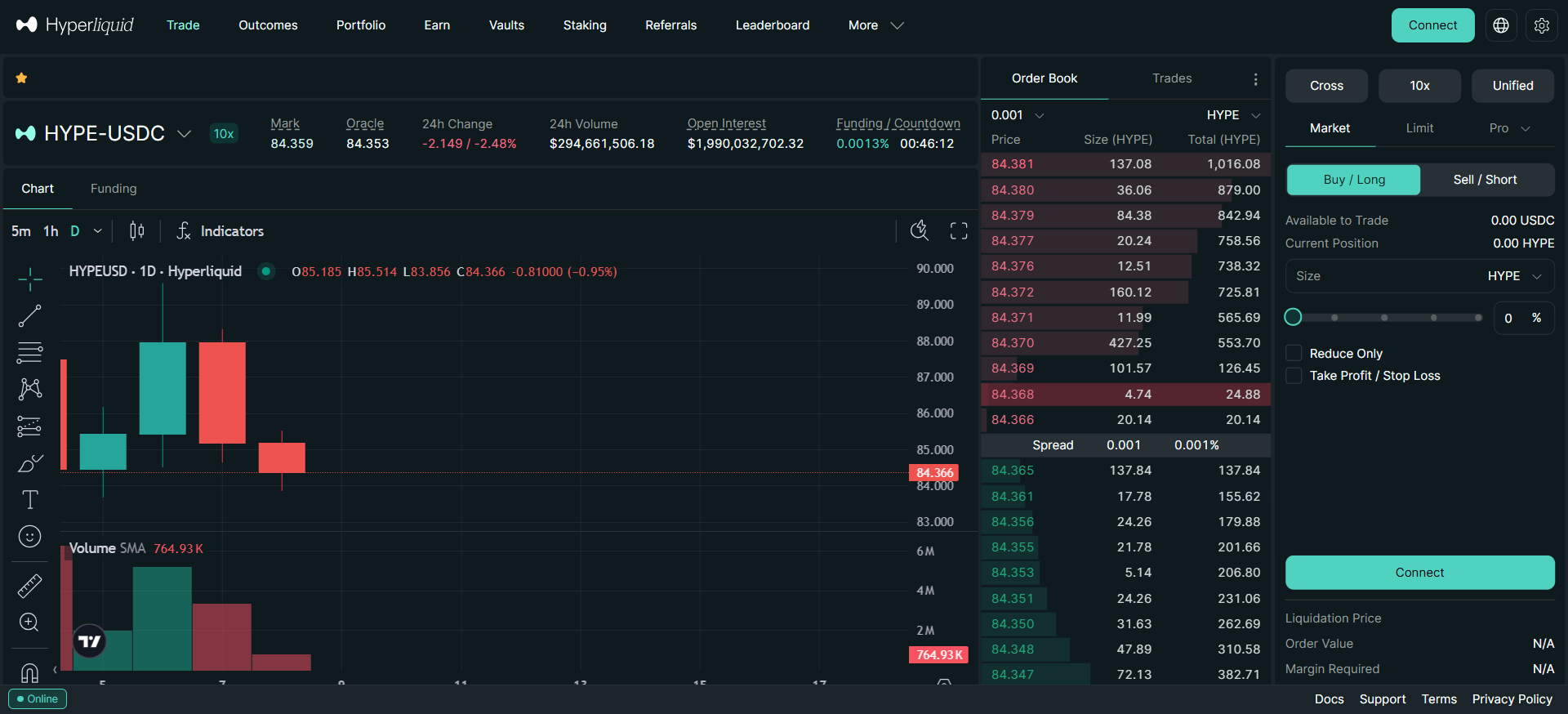 Source: app.hyperliquid.xyz.
How does Hyperliquid’s 14-day fee-tier system work?
Hyperliquid assesses rolling 14-day volume and updates the fee tier at the end of each UTC day. Sub-account volume counts toward the master account, and all sub-accounts share the same fee tier.
| Tier | 14-day weighted volume | Base perp taker | Base perp maker | Base spot taker | Base spot maker |
|---|---|---|---|---|---|
| 0 | Below $5M | 0.045% | 0.015% | 0.070% | 0.040% |
| 1 | > $5M | 0.040% | 0.012% | 0.060% | 0.030% |
| 2 | > $25M | 0.035% | 0.008% | 0.050% | 0.020% |
| 3 | > $100M | 0.030% | 0.004% | 0.040% | 0.010% |
| 4 | > $500M | 0.028% | 0.000% | 0.035% | 0.000% |
| 5 | > $2B | 0.026% | 0.000% | 0.030% | 0.000% |
| 6 | > $7B | 0.024% | 0.000% | 0.025% | 0.000% |
How to read the table: “> $5M” means the threshold must be exceeded. A fee tier is not permanent; it reflects the account’s rolling 14-day weighted volume and is assessed daily in UTC.
What is the difference between a trading fee and funding?
A trading fee is charged when an order executes. Funding is a periodic transfer between holders of opposite perpetual positions, and Hyperliquid says that no fee is collected on the funding payment itself.
- When the perpetual contract trades above the underlying spot oracle price, the funding rate is positive and longs pay shorts.
- When it trades below the oracle price, the funding rate is negative and shorts pay longs.
- Hyperliquid says funding is paid every hour, while the formula uses an eight-hour rate that is divided into hourly payments.
- Your funding outcome depends on your position, the oracle price and the funding rate at the interval; it is not fixed by the maker/taker table.
Risk warning:A low trading fee does not guarantee a low total cost. For a leveraged perpetual position held over time, funding, spread, slippage and liquidation-related effects can matter more than the entry fee.
How much can HYPE staking reduce trading fees?
The official fee schedule lists six HYPE staking tiers, ranging from a 5% discount for more than 10 HYPE staked to a 40% discount for more than 500,000 HYPE staked.
| Staking tier | HYPE staked | Trading-fee discount |
|---|---|---|
| Wood | > 10 | 5% |
| Bronze | > 100 | 10% |
| Silver | > 1,000 | 15% |
| Gold | > 10,000 | 20% |
| Platinum | > 100,000 | 30% |
| Diamond | > 500,000 | 40% |
The discount is applied to trading fees, not to funding transfers. Hyperliquid also documents a staking-linking process for attributing a staking user’s HYPE to a trading user; the documentation warns that linking is permanent and should only be used between accounts controlled by the same user.
How does the Hyperliquid referral discount work?
Using a referral code gives a 4% fee discount on the referred user’s first $25 million in volume. The official documentation says referral discounts do not apply to vaults or sub-accounts because those are treated as independent accounts in the clearinghouse.
- A user can enter a referral code at app.hyperliquid.xyz/referrals or use a referral link.
- Referral rewards and referral discounts have different limits: rewards apply to the first $1 billion of a user’s volume, while the user discount applies to the first $25 million.
- Creating a referral code requires $10,000 in volume, according to the official referral page.
Practical point:A referral discount is a percentage reduction to the applicable trading fee. It does not turn a taker order into a maker order, remove funding, or guarantee that a trade will be profitable.
What special fee exceptions should advanced users know?
The standard table is not the complete story for every market. Hyperliquid’s official documentation describes special treatment for some quote-asset pairs and HIP-3 builder-deployed perpetuals.
- Spot pairs between two spot quote assets have 80% lower taker fees, maker rebates and user-volume contribution, according to the fee documentation.
- Aligned quote assets receive 20% lower taker fees, 50% better maker rebates and 20% more volume contribution toward fee tiers.
- HIP-3 growth mode can reduce all-in fees by at least 90% for eligible markets, but rebates and volume contributions are also reduced by at least 90%. Eligibility and deployer settings matter.
- HIP-3 deployers can configure additional fee shares. Users should inspect the market-specific fee display and the official documentation instead of assuming that the validator-operated perpetual schedule applies unchanged.
What is the simplest way to keep Hyperliquid trading costs under control?
Check the displayed fee before execution, understand whether the order is likely to be maker or taker, and separate trading fees from funding and execution risk.
- Confirm the product: Perpetual and spot markets have different base schedules.
- Check your tier: The fee tier uses rolling 14-day weighted volume and updates daily in UTC.
- Check discounts: HYPE staking and referral discounts have separate rules and limits.
- Estimate the full position cost: Include both sides of a round trip, plus spread, slippage and any funding transfers.
- Recheck market-specific terms: Quote-asset and HIP-3 mechanics can change the applicable result.
Frequently Asked Questions (FAQs)
Q: What is Hyperliquid’s lowest base perpetual fee?
A: The official base schedule lists 0.015% for maker trades and 0.045% for taker trades. Higher volume tiers and eligible discounts can reduce the applicable rate.
Q: Is funding included in the trading fee?
A: No. Hyperliquid describes funding as a peer-to-peer payment between long and short positions, with no fee collected on the funding payment.
Q: Does spot volume count toward Hyperliquid fee tiers?
A: Yes. Perps and spot volume are combined, and the official formula counts spot volume twice toward weighted 14-day volume.
Q: How much does a Hyperliquid referral code save?
A: The official referral page states that a referral code gives a 4% discount on fees for the first $25 million of volume. It does not apply to vaults or sub-accounts.
Q: Does staking HYPE reduce funding payments?
A: The documented staking benefit is a trading-fee discount. Funding is a separate peer-to-peer transfer and is not described as being reduced by the staking discount.
Disclaimer: This article is for educational and informational purposes only and does not constitute financial advice. Cryptocurrency trading, including spot and perpetual contracts (perps), involves high risk and significant price volatility.