


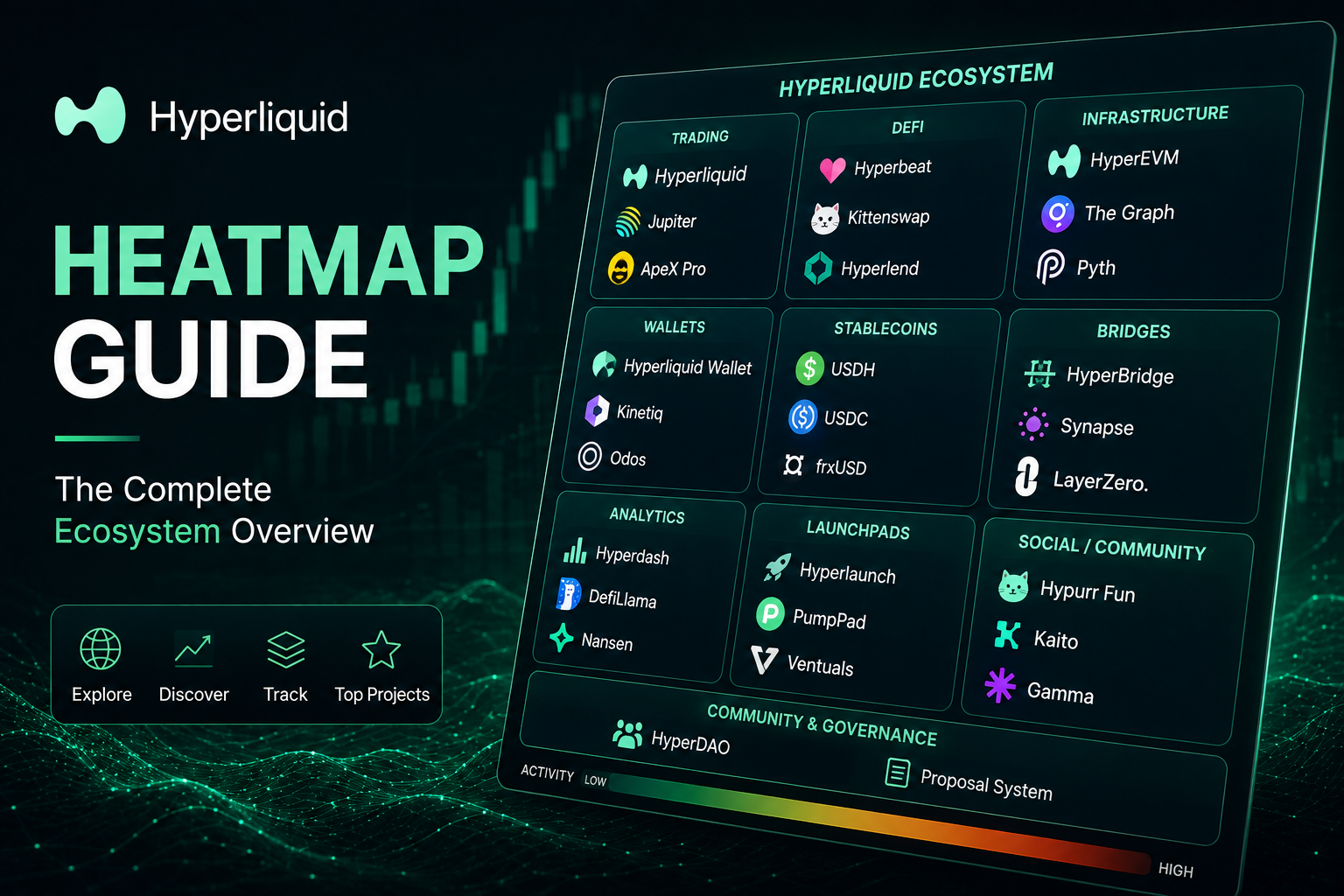
Summary
- Crypto is a CoinDuck analytics filter for cryptocurrency markets; it is not a separate Hyperliquid trading primitive.
- Spot tokens represent token balances traded through spot order books; perps are derivatives with no expiration and funding payments.
- HIP-3 lets eligible builders deploy and operate separate perpetual DEXs with their own markets, settings, and oracle responsibilities.
- HIP-4 adds fully collateralized, fixed-range outcome contracts, including Yes/No-style markets, without leverage or liquidations.
- CoinDuck heatmaps are live dashboards. Their values, rankings, and row counts change; use the linked pages for the current snapshot rather than treating this article as a price feed.
This guide separates the underlying protocol concepts from CoinDuck’s pages so readers can interpret a heatmap without confusing spot ownership, leveraged derivatives, builder-deployed markets, and outcome contracts.
How should you read the Hyperliquid ecosystem at a glance?
Start with the product type, then read the heatmap’s size and color encoding. CoinDuck’s market pages commonly use volume, price change, funding, open interest, and market-count fields, but each page is a live analytics view rather than an immutable protocol specification.
- Spot tokens: Own or exchange token balances through spot books.
- Native perps: Trade derivatives without an expiry date.
- HIP-3: Builder-deployed perp DEXs and markets.
- Crypto view: CoinDuck’s cryptocurrency filter.
- HIP-4: Fully collateralized outcome contracts.
| Layer | What it is | Core question | Main risk distinction |
|---|---|---|---|
| Spot | Onchain token balances and spot order books. | Do you want exposure to the token itself? | Price and liquidity risk; no perp liquidation mechanism. |
| Native perps | Non-expiring derivative contracts. | Do you want leveraged long or short exposure? | Funding, margin, and liquidation risk. |
| HIP-3 | Builder-deployed perp DEXs using HyperCore infrastructure. | Who defines and operates the market? | Oracle, deployer, collateral, and market-operation risk. |
| HIP-4 | Fixed-range, fully collateralized outcome contracts. | Which outcome side will settle? | Settlement and event-definition risk; no leverage or liquidation. |
What are HIP-3 assets and how do builder-deployed perps work?
HIP-3 is Hyperliquid’s framework for permissionless builder-deployed perpetual markets. The deployer defines the market, oracle, and contract specifications, then operates the market by setting oracle prices, leverage limits, and settlement behavior.
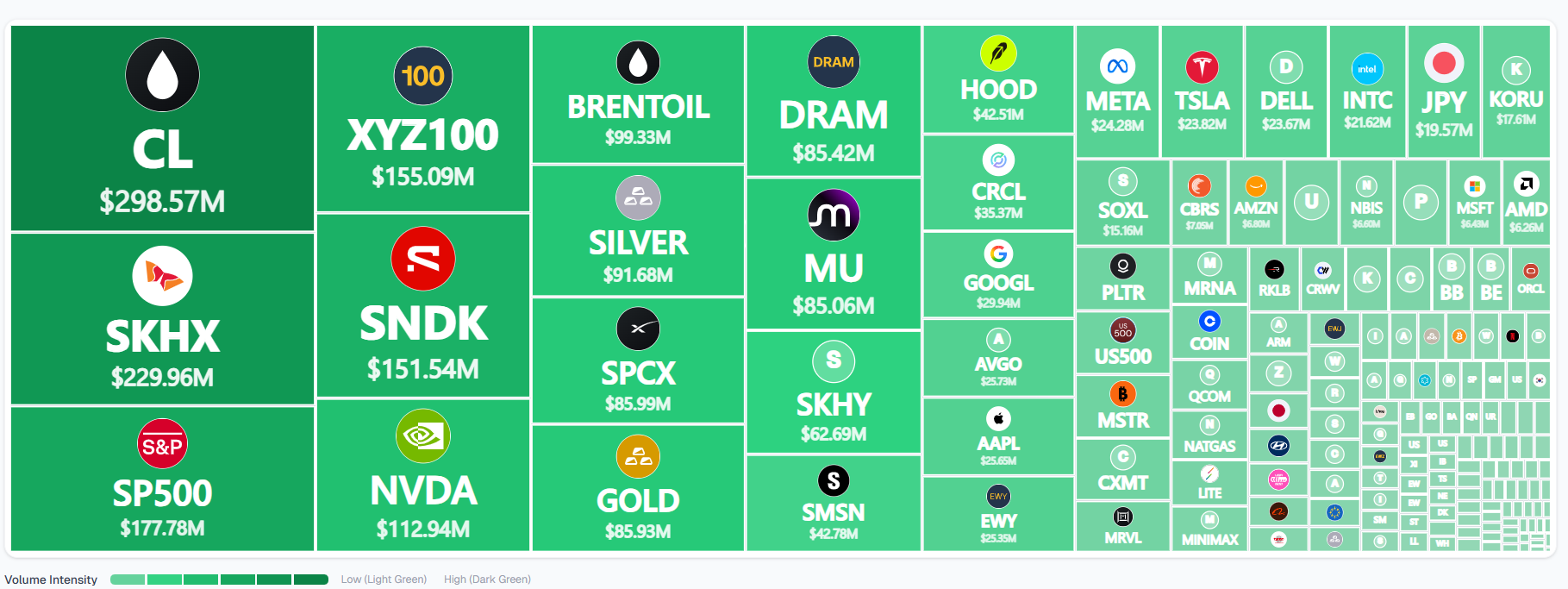 Source: Hip-3 Assets
- Identify the deployer namespace. HIP-3 markets belong to a builder-deployed perp DEX, so the market label can carry a namespace or deployer identifier.
- Check the market definition. The builder is responsible for the oracle definition and contract specifications, so the collateral and leverage settings are not automatically identical across every HIP-3 DEX.
- Read operational risk. Each perp DEX has independent margining, order books, and deployer settings. Deployer actions are onchain, and the protocol includes staking and validator-slashing mechanisms tied to defined HIP-3 behavior.
HIP-3 is not simply a new ticker list.
The deployer’s oracle and operational responsibilities are part of the product. A market’s name alone does not tell you its collateral, leverage, oracle construction, or settlement rules.
The official HIP-3 specification currently describes a 500,000 HYPE mainnet staking requirement, a minimum maintenance period after deployment, and independent DEX settings. These parameters are protocol-specific and should be checked in the latest documentation before relying on them.
What are Hyperliquid perpetual markets?
Perpetual markets are derivatives that have no expiration date. Hyperliquid’s documentation explains that funding payments help the contract converge toward the underlying spot price over time.
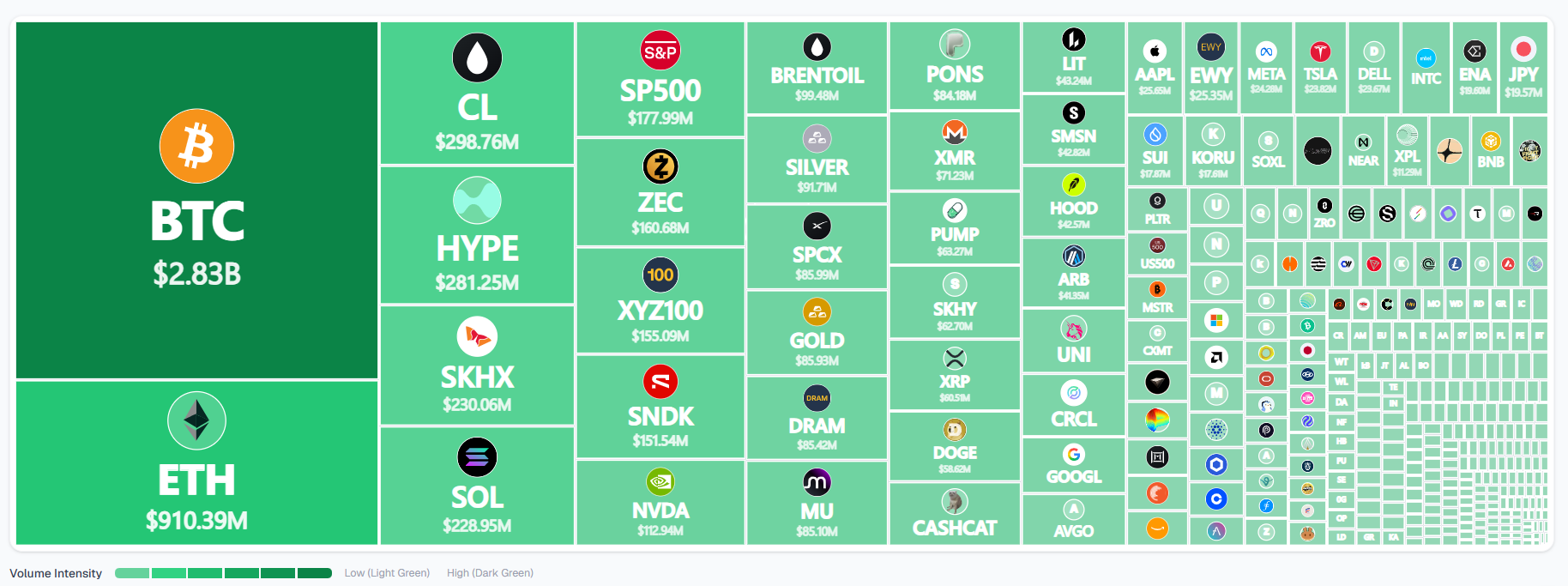 Source: Hyperliquid Perp Markets
- Price: the dashboard’s displayed market price, which is time-sensitive.
- 24h change: a recent performance field, not a forecast.
- Funding (8h): a periodic funding field shown by CoinDuck; funding mechanics and intervals should be confirmed in the market documentation.
- Open interest: the amount of outstanding perp exposure represented by the dashboard’s data.
- Volume (24h): recent trading activity used by CoinDuck to size its heatmap blocks.
A perp position is not ownership of the underlying spot token. Margin, leverage, funding, and liquidation rules make the risk profile materially different from buying and holding a spot asset.
What are Hyperliquid spot tokens?
Spot tokens are fungible onchain assets traded through spot order books. Under HIP-1, token deployment specifies parameters such as name, decimal settings, maximum supply, and optional genesis balances. Any HIP-1 token is initialized with a native spot order book using Spot USDC as its initial quote asset.
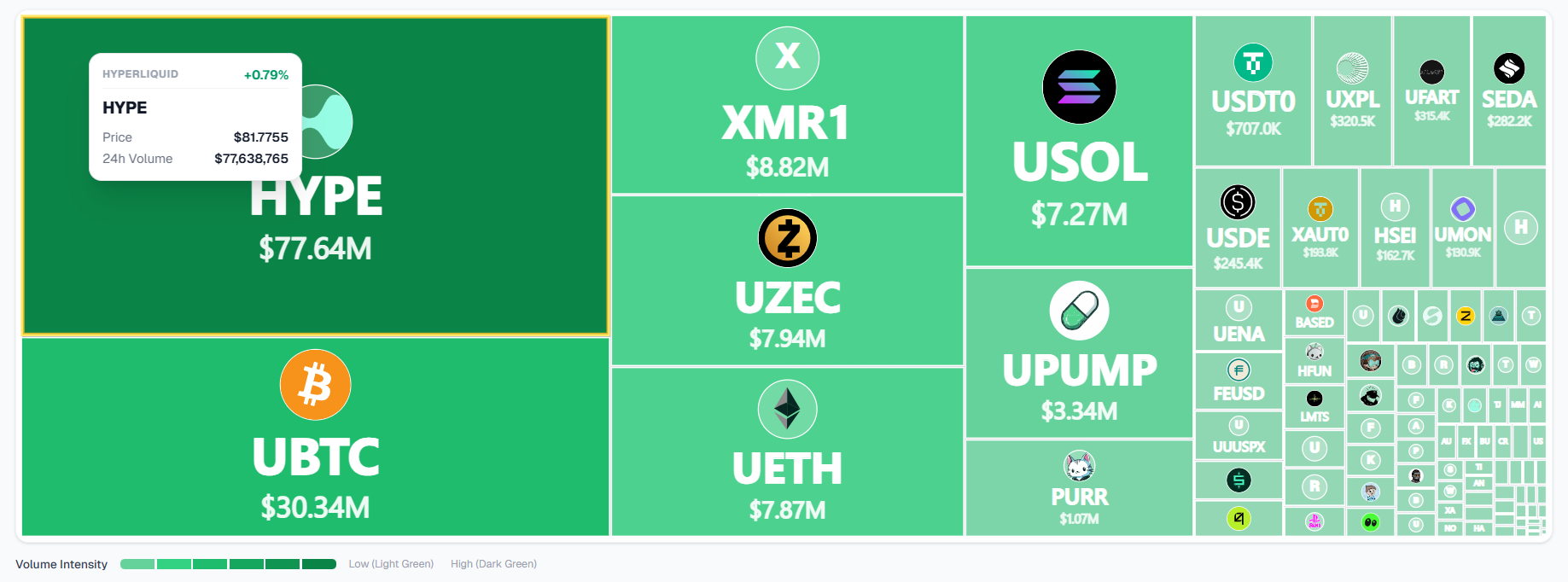 Source: Hyperliquid Spot Trading Market
Spot trading answers a different question from perps: instead of opening a derivative position, the user exchanges one token balance for another through an order book. Hyperliquid’s documentation also describes USDC as both the collateral used for perps and a spot token with an atomic transfer between perp and spot wallet USDC.
Practical distinction: a spot market is about the asset balance you hold; a perp market is about a derivative position whose margin and funding rules must be managed.
What does the CoinDuck Crypto heatmap show?
The Crypto page is a filtered analytics view for cryptocurrency markets on Hyperliquid. It is not a fifth protocol primitive alongside spot, native perps, HIP-3, and HIP-4.
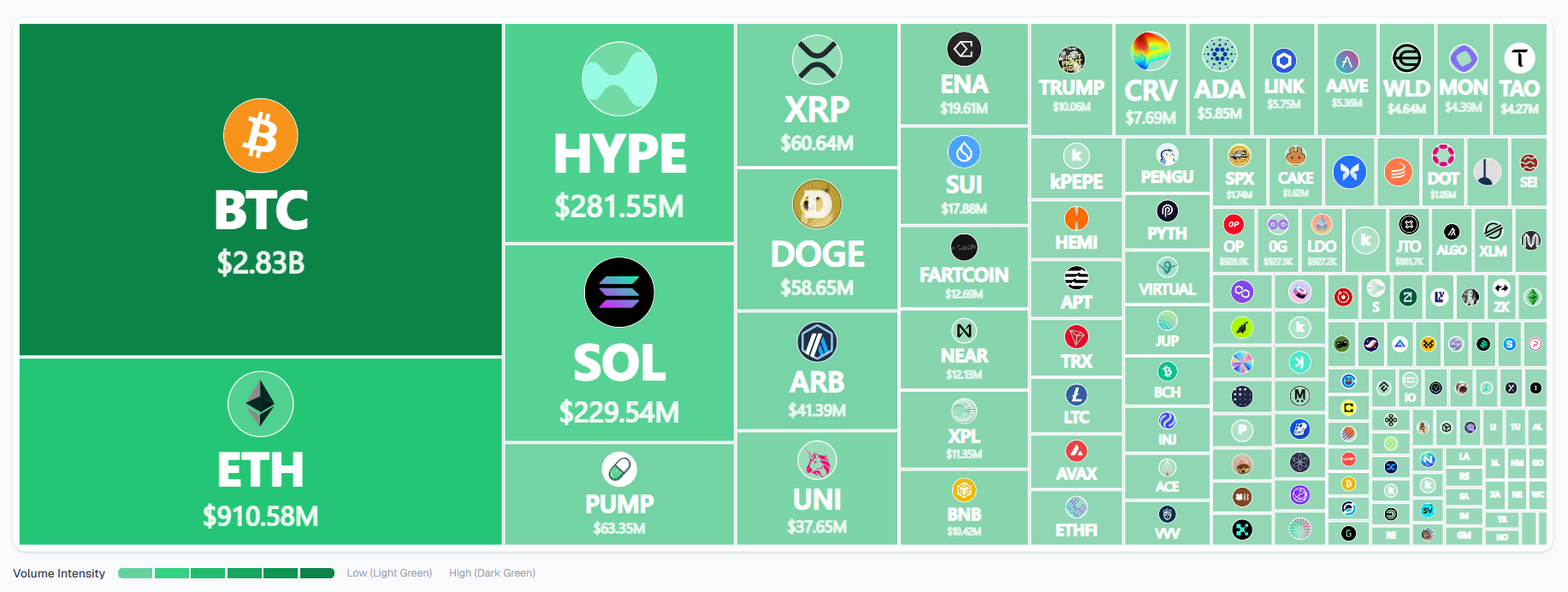 Source: Crypto Heatmap
The captured CoinDuck page used market, price, 24-hour change, funding, open interest, and 24-hour volume columns. Its rows included leverage labels, which indicates that the page’s visible market table is presenting crypto perp data in that view. Do not assume that every row represents a spot token simply because the page is titled “Crypto”.
- Use the category filters to narrow the dashboard’s crypto-market universe.
- Use volume and change together: a large move with low volume may tell a different story from a large move with deep activity.
- Check the timestamp and live page before quoting any price, volume, funding, or open-interest number.
What are HIP-4 outcome markets?
HIP-4 introduces fully collateralized contracts that settle within a fixed range. Hyperliquid describes them as a general-purpose primitive for prediction markets and bounded options-like instruments, with no leverage or liquidations.
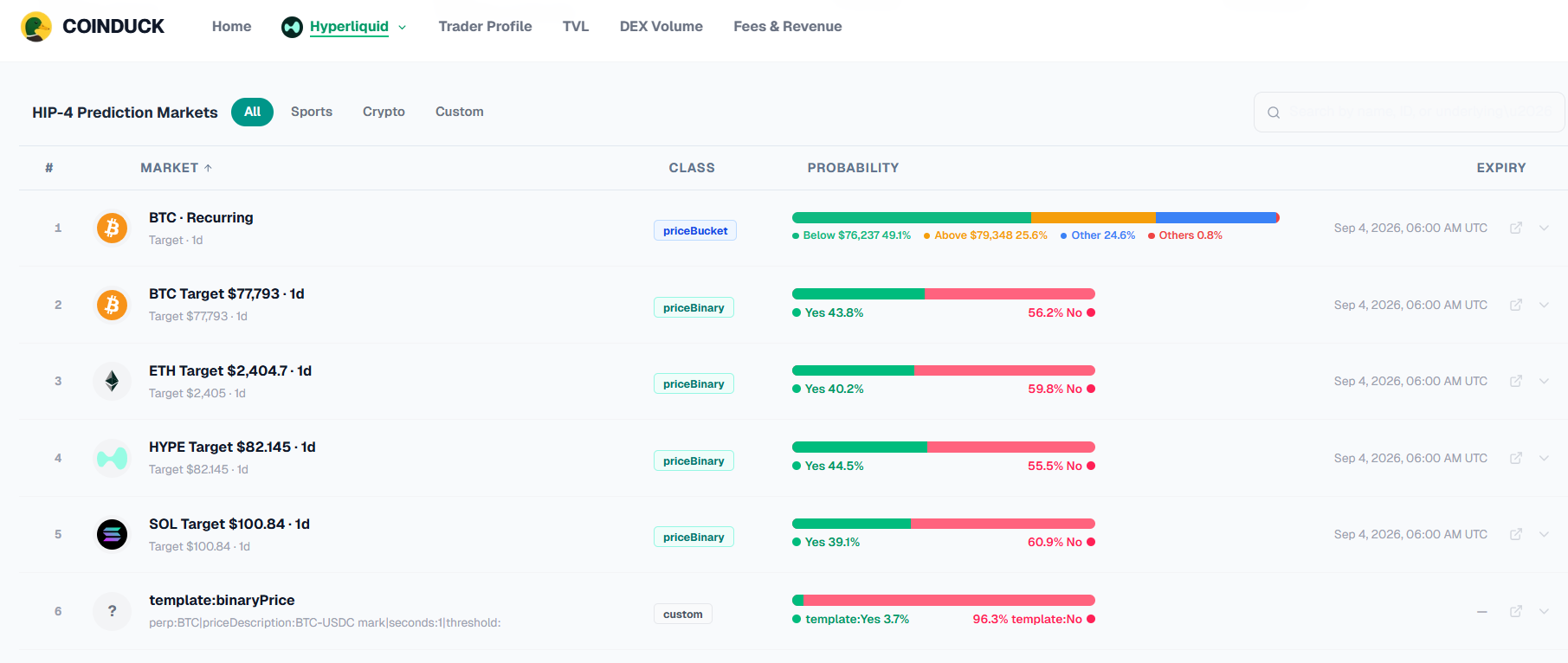 Source: Hip-4 Prediction Market
- Understand the two sides. An outcome market consists of two sides, each represented by a token, often labeled Yes and No.
- Understand settlement. At settlement, Yes and No convert into quote tokens according to the settlement fraction. A binary Yes settles at a fraction of 1; a binary No settles at 0.
- Understand the first documented market. Hyperliquid’s official HIP-4 page describes the first market as a recurring binary outcome settling daily at 06:00 UTC against HyperCore BTC mark prices. It also says multi-outcome markets were not part of the initial mainnet release.
Do not read HIP-4 like a perp.
The outcome primitive has dated settlement and binary-style payoff mechanics. It is not a leveraged perpetual position, and the documentation explicitly distinguishes it by the absence of leverage and liquidations.
How should you use the five CoinDuck heatmaps step by step?
Use the pages as a sequence: scope, filter, compare, then investigate the market specification. The heatmaps help organize live market data, while Hyperliquid’s documentation defines the mechanics.
- Choose the product. Start with Spot Tokens for asset ownership, Perp Markets for derivatives, HIP-3 for builder-deployed perp namespaces, or HIP-4 for outcomes.
- Use Crypto as a category view. Apply CoinDuck’s crypto filters when you want to compare cryptocurrency markets rather than the full perp universe.
- Read the size encoding. On CoinDuck’s perp and crypto pages, the heatmap states that size represents 24-hour volume and color represents volume intensity. This helps distinguish activity from direction.
- Open the market details. Review funding, open interest, collateral, leverage, oracle, and settlement rules before interpreting a row as a trade idea.
- Separate live data from definitions. Treat prices, rankings, volumes, and market counts as changing dashboard values. Treat HIP-1, HIP-3, HIP-4, and contract-specification details as documentation claims that should still be rechecked after protocol updates.
What risks should readers keep in mind?
The largest risk is confusing an analytics label with a market’s actual contract design. A heatmap can show activity, but it cannot replace the market specification or explain every oracle, collateral, margin, settlement, and liquidation condition.
- Leverage and liquidation: relevant to perps, but not equivalent to spot ownership or HIP-4’s fully collateralized outcome structure.
- Oracle risk: especially important for HIP-3 because the deployer defines and operates the market’s oracle framework.
- Liquidity risk: high displayed volume does not guarantee that every order size will execute without slippage.
- Data freshness: CoinDuck values can change quickly; the captured screenshots are visual references, not a live quotation service.
- Protocol and counterparty risk: onchain execution, smart-contract behavior, bridge design, wallet security, and platform availability can all affect outcomes.
Frequently Asked Questions (FAQs)
Q: Are HIP-3 assets spot tokens?
A: No. HIP-3 refers to builder-deployed perpetual markets. Spot tokens are governed by the HIP-1 native-token and spot-order-book framework.
Q: Is the CoinDuck Crypto page a separate Hyperliquid market type?
A: No. It is an analytics filter for cryptocurrency markets. Its displayed rows can include perp-style leverage labels, so it should not be treated as a separate protocol primitive.
Q: Do Hyperliquid perps expire?
A: The official contract documentation describes them as perpetual derivatives without an expiration date. Funding payments help the contract converge toward the underlying spot price over time.
Q: Do HIP-4 markets use leverage?
A: The official HIP-4 documentation describes outcomes as fully collateralized and says they do not involve leverage or liquidations.
Q: Can I use a heatmap alone to decide whether to trade?
A: No. A heatmap summarizes selected live metrics. Review the market’s specification, liquidity, oracle, collateral, funding, margin, and settlement terms before making any trading decision.
Disclaimer: This content is for informational purposes only, not financial advice. Crypto trading involve substantial risk, including loss of the capital committed. Review the official Site before trading crypto.