Jupiter began as a simple tool. It found you the best price when you swapped tokens on Solana. Now it wants to be a full money app. On November 10, 2026, the team announced four new products: Jupiter Baskets, Jupiter Vaults, Portfolio V3, and Pulse. Together, they let you find, buy, grow and track your crypto in one place.
In this guide, we explain each product in plain words. We also look at what it could mean for Solana DeFi, and which risks you should know about before you try anything.
Quick answer: what did Jupiter launch?
Jupiter launched four products. Baskets let you buy many tokens with one deposit. Vaults offer yield strategies run by outside experts called curators. Portfolio V3 shows your positions and lets you act on them from one page. Pulse is a set of research tools with rebuilt token pages. Portfolio V3 is live now. Vaults opens as a private beta on November 11.
Key takeaways
Jupiter is launching four things: Baskets, Vaults, Portfolio V3, and Pulse with rebuilt token pages.
Baskets let you buy a group of tokens with one deposit instead of many separate swaps.
Vaults offer yield strategies run by outside curators. A private beta opens on November 11.
Portfolio V3 is live now. You can act on your positions from one page.
Every Vaults strategy carries risk, including the possible loss of funds.
Most details here come from Jupiter's announcement on November 10, 2026, as reported by Decrypt. Some features are still rolling out, so things may change.
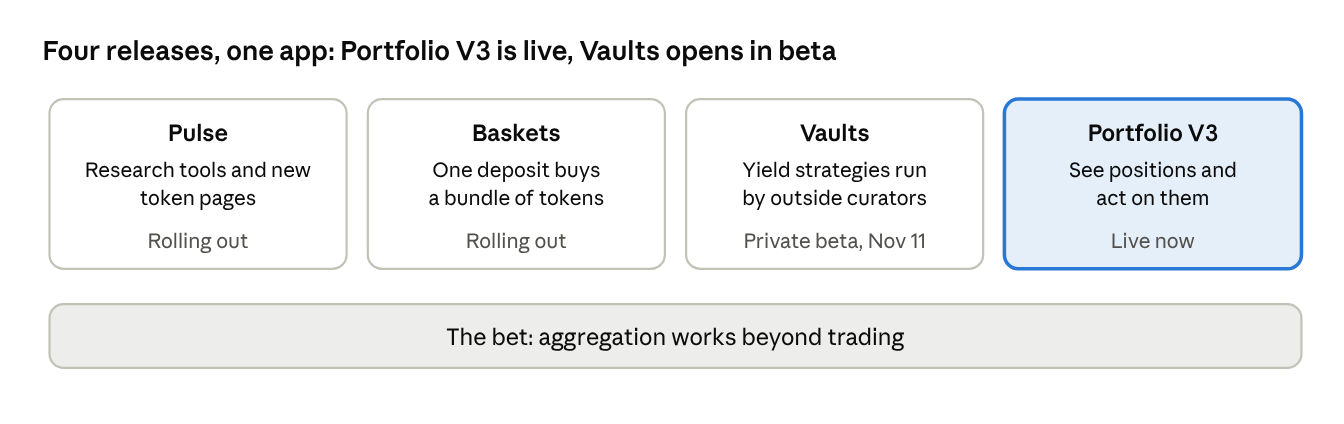
The four Jupiter releases at a glance. Portfolio V3 is live. Vaults opens first as a private beta. The rest roll out over the coming days.
Why is Jupiter launching new products?
Jupiter is the largest trading platform on Solana. Its main trick is called aggregation. Instead of sending your trade to one place, Jupiter checks many places on Solana and picks the route with the best price. The company says it has now handled more than $1.3 trillion in total aggregator volume.
Think of a travel booking site. You do not visit every airline one by one. The site checks them all and shows you the best deal. Jupiter does the same for token trades.
Now the team wants to use this idea beyond trading. Kash Dhanda, Jupiter's chief operating officer, says the same approach can work for everything people do with assets. Jupiter also shared a new mission: to make the world's assets easy to access and useful.
Why does this matter? Trading is only one step. Most people also want to hold, earn on and track what they own. Today that often means many apps and browser tabs. Dhanda has said he used to keep a dozen tabs open, plus a spreadsheet, just to follow his positions.
Jupiter also shared a few numbers. It says its wider ecosystem holds about $1.7 billion in total value locked (TVL), based on DeFiLlama data from early November. It also says its lending market has passed $1 billion in active loans. These are Jupiter's own figures, so treat them as company claims. You can compare them with live data on our Jupiter analytics page. We explain how we collect our numbers on the data methodology page.
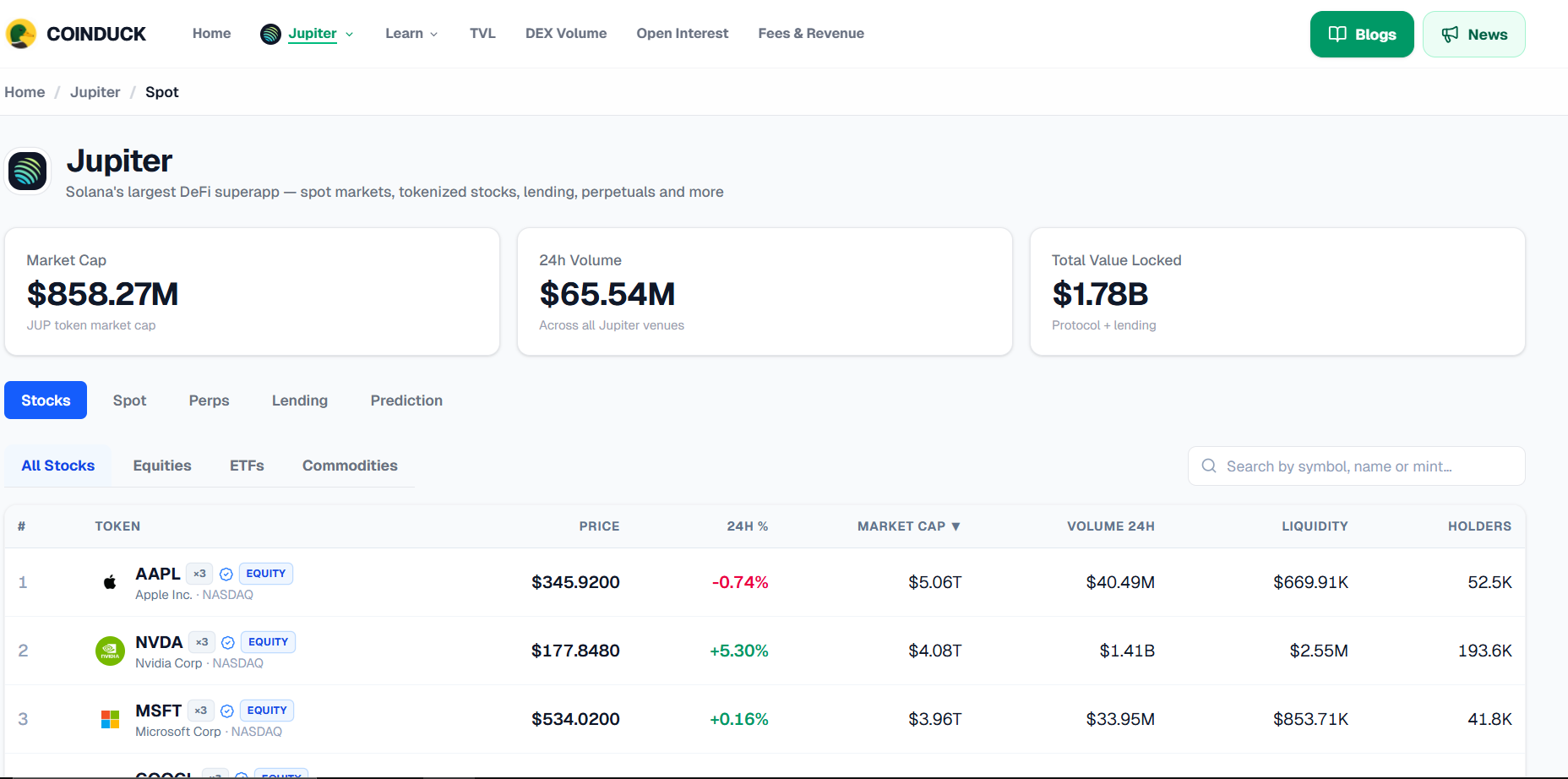
Live Jupiter stats on CoinDuck. Compare them with the numbers Jupiter shared.
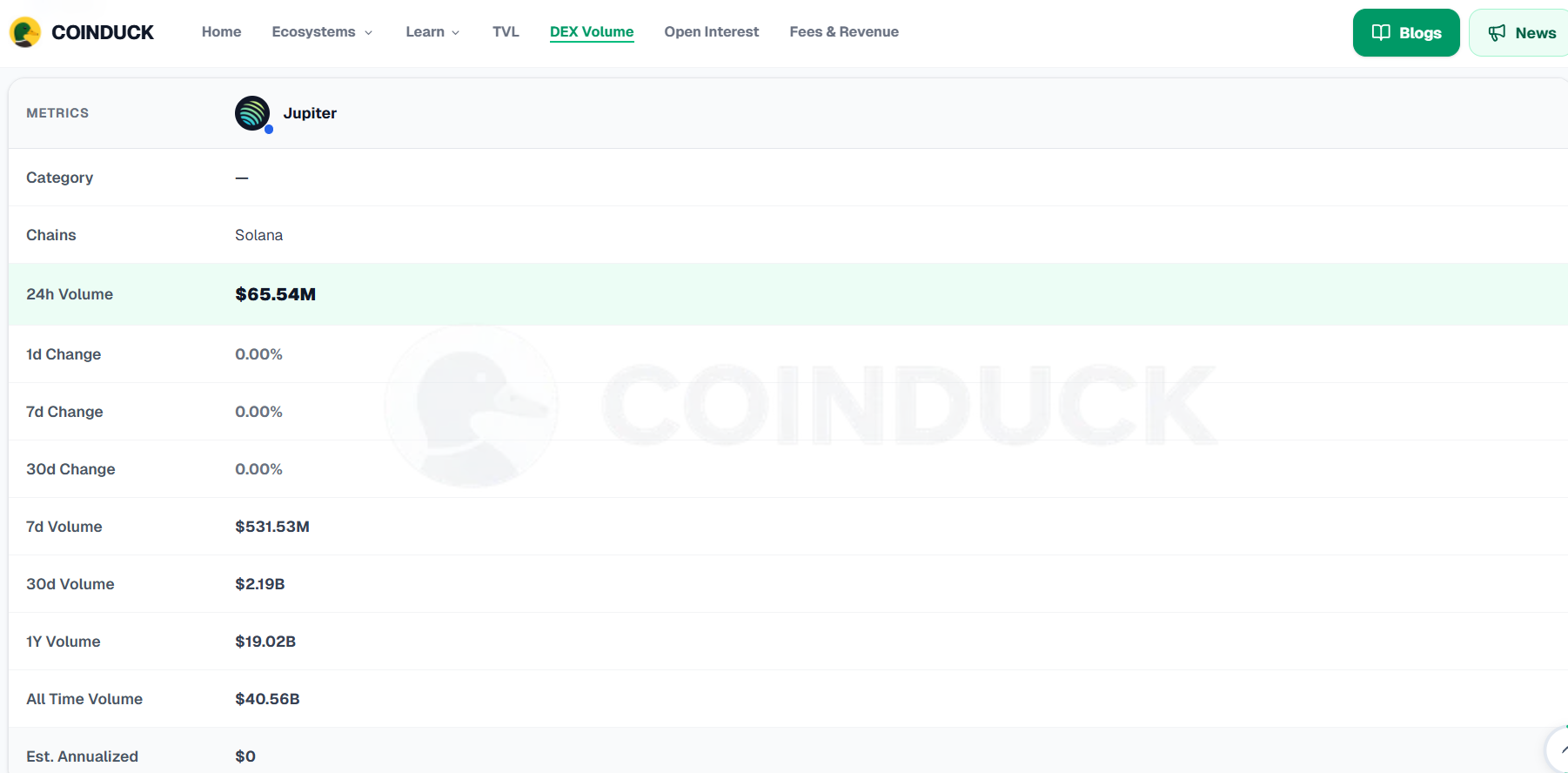
DEX volume trend on CoinDuck. Jupiter routes trades across many Solana venues.
To see how trading volume is measured, read our guide on what trading volume is.
Jupiter Baskets: many tokens, one deposit
Baskets are the easiest idea of the four to understand.
Say you want to own five tokens. Normally you make five swaps, check five prices, and repeat the work when you sell. That is slow, and mistakes are easy to make.
With a basket, you make one deposit of SOL or USDC. Jupiter spreads it across all the tokens in the basket for you.
How a basket can be set up
According to the announcement, a basket can follow one of two styles:
Market-cap weights. Bigger tokens get a bigger share. Smaller tokens get a smaller one.
Fixed targets. The basket aims for set shares, for example 50% in one token, 30% in another and 20% in a third.
Baskets can also rebalance on their own. Here is an example. Say your basket is split evenly between two tokens. One token doubles in price, so it now takes a much bigger part of your basket than you planned. Rebalancing sells a little of the winner and buys more of the other token. This brings the split back to normal.
Every deposit, rebalance and exit goes through Jupiter's routing, so each step should get the best available price.
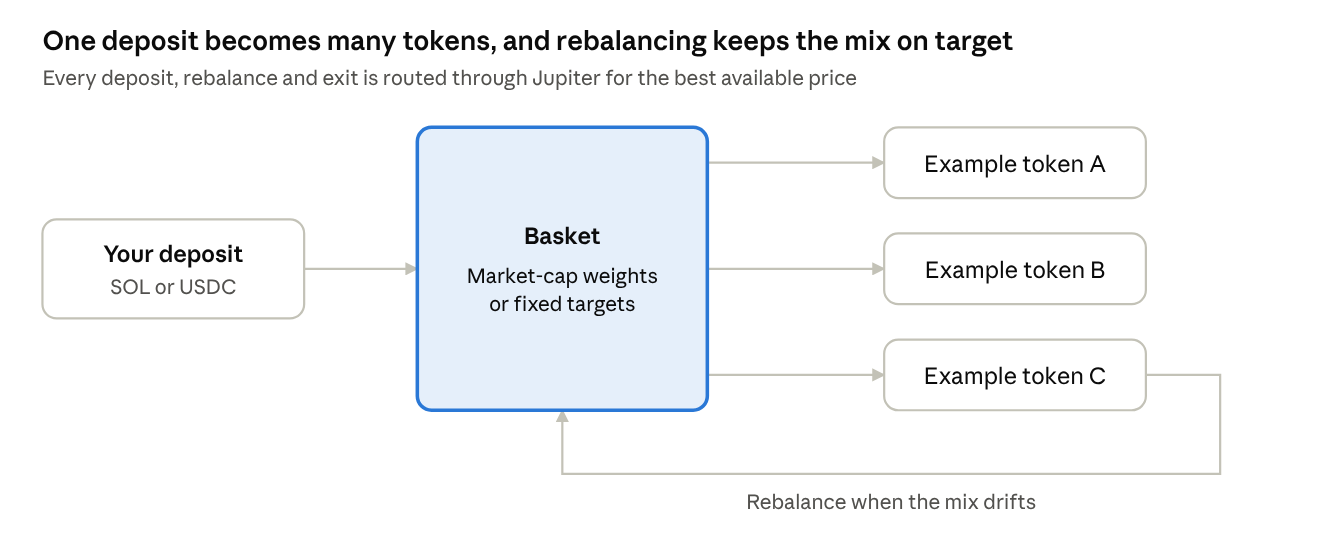
How a basket works: one deposit, three example tokens. Rebalancing keeps the mix close to your plan.
Who might like Baskets?
Baskets may suit people who want a theme or a group of tokens without picking one winner. They also help busy people who do not want to manage many small swaps. The idea is close to an index fund, but on chain.
One thing to know: the announcement did not share fees or the exact token list for each basket. Before you deposit, check what is inside, how the shares are set, and what it costs.
Jupiter Vaults: yield run by outside curators
Vaults may be the most important launch of the four. It moves Jupiter from trading into earning.
Jupiter Vaults is a new hub for yield strategies. They range from stablecoin lending to strategies backed by real-world assets. The key detail is who runs them. Independent curators manage the strategies, not Jupiter.
What is a curator?
A curator is a person or a team that decides where the money in a vault goes and how risk is handled. Think of them as a fund manager for one strategy.
Here is a simple example. A vault takes USDC deposits. The curator lends that money across a few lending markets and collects interest. You earn a share. This is only an example, not a real vault. To learn the basics, read our guide on what crypto lending is.
The curator model is not new in DeFi. You can already see similar ideas on Morpho and Aave, and you can follow their data on CoinDuck. If you want to see how on-chain borrowing works on another network, read post on Hyperliquid manual borrows.
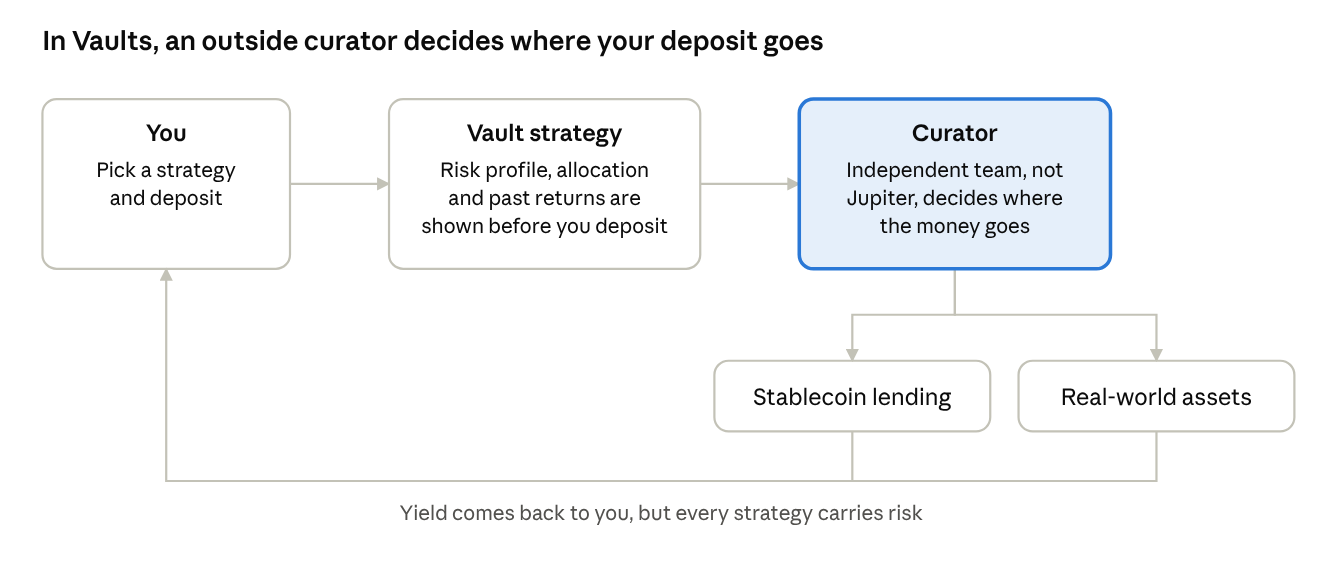
How a vault works: deposit, curator, strategy. Your deposit follows the curator's choices, so check who runs a strategy first.
What you can see before you deposit
Jupiter says users can look at each strategy's risk profile, how the money is split, and its past returns before depositing. That is a good start. But past returns never promise future returns. Use them as one clue, not the full story.
Who can use Jupiter Vaults now?
Vaults opens on November 11 as a private beta. It is open to more than 19,000 people on the waitlist, plus eligible holders of staked JUP. Jupiter also says some strategies may not be available in every region, including the United States.
Are Jupiter Vaults safe?
In an October interview, Dhanda said Jupiter's yield products are audited several times before they reach users. He also said that if something goes wrong because of Jupiter, the team would want to work with users on a fix. Jupiter is looking at ways to insure these products on chain.
That is encouraging, but it is a statement of intent, not a guarantee. For now, assume there is no safety net. You can read the general warnings on our risk disclosure page.
Portfolio V3: one page to see and act
Portfolio V3 is the only one of the four that is already live.
Older portfolio pages mostly showed what you own. The new version lets you act. From the page, you can trade, open perpetual futures, make predictions, or lend.
Two extras stand out:
Liquidation alerts. If you use leverage, a position can be closed by force when losses get too big. This is called liquidation. Portfolio V3 can warn you when a position is getting close.
Cross-chain transfers. The page can move funds between chains by combining several bridges, so you do not have to pick one bridge yourself.
For anyone who has lost track of positions across apps, this is the most practical change of the four.
Jupiter Portfolio V3 (source: Jupiter, captured on [date]).
Pulse and new token pages: research before you trade
The last release is about research. Jupiter is launching Pulse and rebuilt token pages, so you can learn about an asset before you buy it.
The new pages show market data for tokenized stocks and ETFs. For DeFi projects, they show tokenomics. That word simply means how many tokens exist, who holds them, and how new ones are released over time. A sidebar also lets you compare tokens side by side.
The goal is clear. Jupiter wants to be the place where you discover an asset, study it, trade it and track it. Dhanda has said that putting assets on chain is only the first step of tokenization, not the end.
If you want to browse tokenized stocks and ETFs with price, volume and liquidity side by side, our Jupiter page has a sortable table of them.
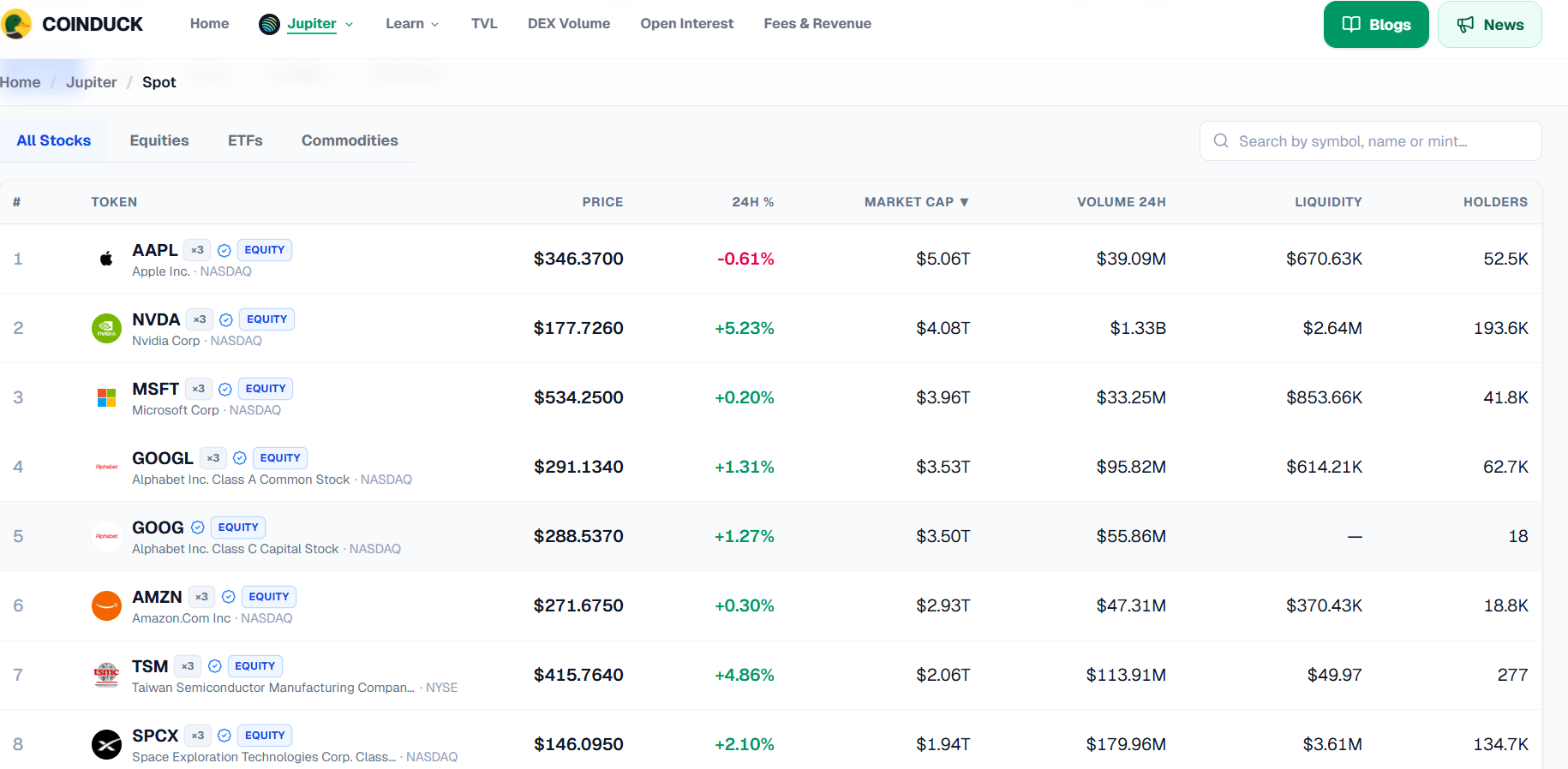
Tokenized assets table on CoinDuck (captured on [date]).
What this means for Solana DeFi
Here is how we see the bigger picture.
1. Aggregators are becoming all-in-one apps. Jupiter built its name on routing swaps. Now it adds baskets, yield, portfolio tools and research. If it works, users will not need many different apps. That also means more competition. Last week, Solana Labs' new company Leap launched a beta mobile app for trading tokenized stocks, ETFs, metals, currencies and crypto in one place. The race to be the main money app on Solana is getting busy.
2. Curated yield may grow. Vaults gives outside teams a way to reach Jupiter's users. That could bring more choice for people who do not want to build their own strategy. The other side is trust. When a curator makes the decisions, you trust the curator as well as the code.
3. The timing is no accident. The launches come right before Solana Breakpoint, the network's yearly conference, which starts on November 15. Solana also finished a big upgrade called Alpenglow in October. According to Decrypt, it cut the time for a transaction to become final from about 12.8 seconds to roughly 150 milliseconds. A faster network helps apps like these feel smoother.
4. New numbers to watch. If Vaults grows, new deposits should show up in DeFi data. Total value locked, lending activity, DEX volume and protocol income are the simple signals to follow over the next few weeks. You can track them on our TVL, DEX volume and fees and revenue pages.
Risks to keep in mind
New products are exciting, but they are also new. Here are the main risks.
Smart contract risk. Even audited code can have bugs. Audits lower the risk. They do not remove it.
Curator risk. A vault is only as good as the people running it. Look at who the curator is and how they handle risk.
Strategy risk. Strategies backed by real-world assets or complex lending can fail in ways that are hard to see from outside.
Basket risk. Some tokens in a basket can be small and very volatile. A basket is not safe just because it holds many tokens.
Beta risk. Early versions can have missing features and rough edges.
Regional limits. Some Vaults strategies may not be open to everyone, including people in the United States.
A simple rule helps: never put in money you cannot afford to lose, and start small while you learn how each product works.
What to watch next
The Vaults beta. Will it open to everyone, and which curators and strategies will appear first?
Fees and details. The announcement left out many specifics for Baskets and Vaults. Look for them before you deposit.
Solana Breakpoint on November 15. Jupiter says it will share more details on each release before the event.
Real usage. The best test is whether people actually deposit. Watch TVL and lending numbers on our Jupiter page.
Frequently asked questions
What are Jupiter Baskets?
Baskets let you buy a bundle of tokens with one deposit of SOL or USDC. They can follow market-cap weights or fixed targets, and they can rebalance automatically.
What are Jupiter Vaults?
Vaults is a hub for yield strategies, from stablecoin lending to real-world asset strategies. Independent curators run the strategies, not Jupiter.
Who can use Jupiter Vaults right now?
A private beta opens on November 11 for more than 19,000 waitlist members and eligible holders of staked JUP. Some strategies may not be available in all regions, including the United States.
Is Jupiter Portfolio V3 live?
Yes. Portfolio V3 is live now. The other releases are rolling out over the coming days.
Are Jupiter Vaults safe?
No yield product is risk-free. Jupiter says all Vaults strategies carry risk, including the possible loss of funds. Do your own research first.
What is Jupiter Pulse?
Pulse is a set of research tools with rebuilt token pages. They show market data for tokenized stocks and ETFs, tokenomics for DeFi projects, and a sidebar to compare tokens.
Final thoughts
Jupiter is moving from a place where you trade to a place where you can also invest, earn and track your money. Baskets make it easier to own many tokens. Vaults open the door to curated yield. Portfolio V3 puts your positions in one place. Pulse helps you research before you buy.
Whether this plan works depends on a few things: how safe the products are, how clear the fees are, and whether users trust the curators. It is still early. Watch the numbers, read the details, and take it one step at a time.
Disclaimer: This article is for information only. It is not financial, legal or investment advice. Crypto is risky and you can lose all your money. Always do your own research.