


Summary:
The update improves pricing data for perpetual markets linked to off-chain assets (equities, commodities, FX, etc.). Lighter RWA markets are not limited to Chainlink—they can use multiple oracle providers.- Improves pricing for perpetuals on non-blockchain assets (equities, commodities, FX, and others).
- Does not mean every Lighter market uses Chainlink.
- Lighter RWA markets support multiple oracles: Chainlink, Pyth, and Stork.
What exactly did Lighter expand?
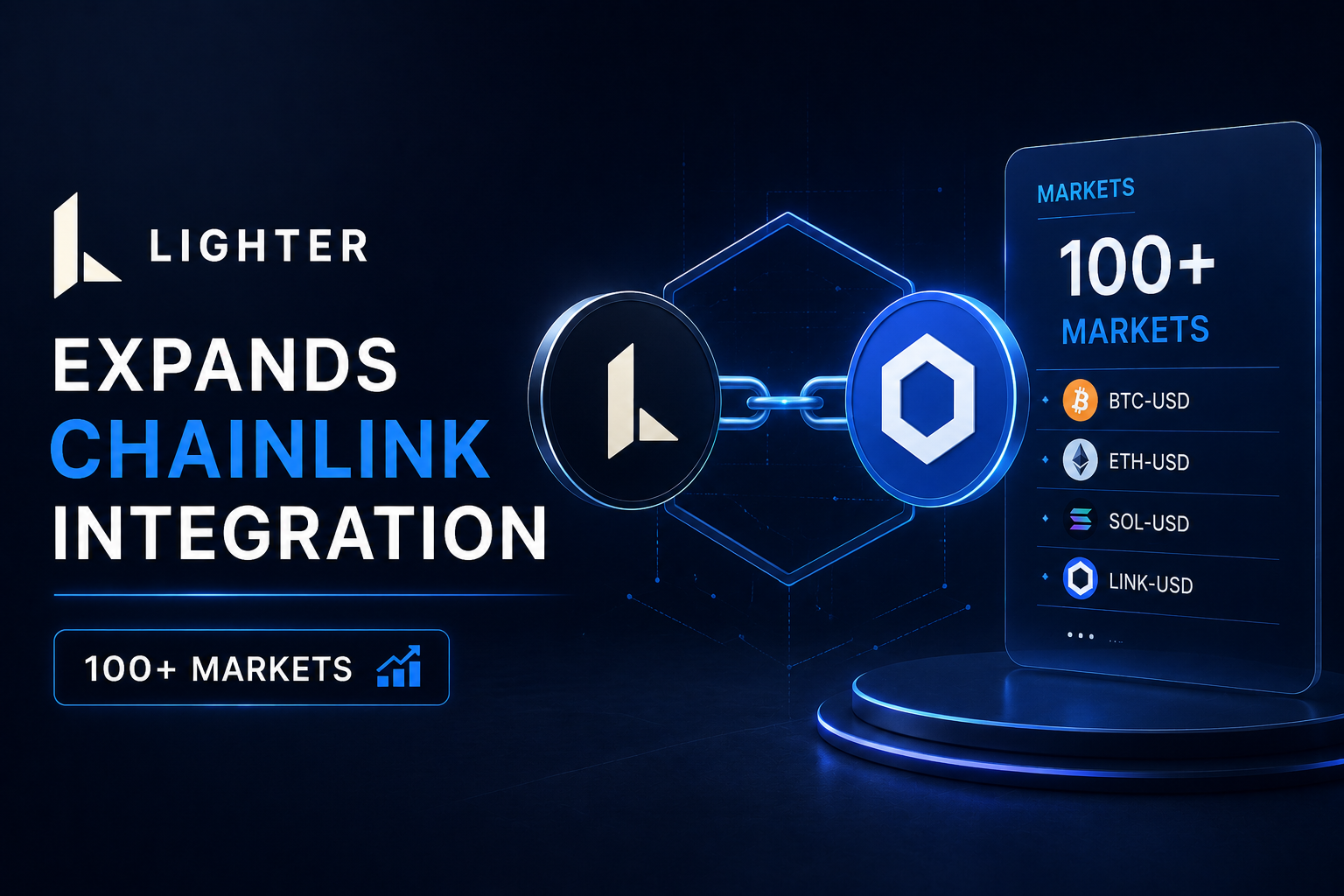
Lighter expanded its Chainlink integration to more than 100 additional markets, bringing the reported coverage to more than 125 markets in total.
- Previous scope: Chainlink Data Streams had already been designated as Lighter’s official oracle solution for its RWA markets in November 2025.
- New coverage: the expansion adds Chainlink’s 24/5 U.S. Equities Streams to the integration.
- Reported total: independent coverage describes more than 125 markets using the expanded Chainlink integration.
- Asset categories: the reported expansion spans equities, commodities, foreign exchange and other derivatives markets.
The “100+” figure should be read as more than 100 additional markets, not as the total number of markets on Lighter. The reported total is more than 125, while Lighter’s broader RWA market list includes markets that use different pricing sources.
Why are oracle feeds important for Lighter’s RWA markets?
Oracle feeds connect off-chain asset prices to on-chain derivative markets, helping Lighter calculate reference prices and manage products linked to assets such as stocks, metals and currencies.
A Bitcoin market can draw on extensive crypto-native trading data. A perpetual contract tracking an equity or a commodity needs information from markets outside the blockchain. That makes the quality, timing and availability of the external feed central to pricing and risk controls.
Lighter’s official RWA pricing documentation describes a two-part system. External oracle feeds are the primary source. If oracle data becomes stale, Lighter shifts toward internal pricing derived from order-book impact prices and smoothed with a time-weighted exponential moving average. When an external price becomes available again, the internal price converges back toward it.
Pricing path:
- External oracle data provides the primary reference.
- Lighter monitors the availability and freshness of that data.
- If the external feed becomes stale, internal order-book pricing is used as a fallback.
- When external data returns, the internal price converges toward the external reference.
What does Chainlink’s 24/5 equity data add?
Chainlink’s 24/5 U.S. Equities Streams are designed to provide equity and ETF data during regular, pre-market, post-market and overnight sessions, five days per week.
Traditional U.S. equity trading is organized around market sessions, while blockchain-based markets can operate continuously. A feed that covers only regular exchange hours can leave an on-chain equity derivative working with stale or incomplete information outside those hours. Chainlink’s 24/5 product is intended to narrow that gap.
The feed is more than a single price point. Chainlink’s official documentation lists several fields that can help a market operator interpret current conditions:
- Market status: identifies phases such as pre-market, regular hours, post-market, overnight and closed.
- Bid and ask data: supplies price and volume fields for the available order-book view.
- Mid price: provides a central reference between bid and ask prices.
- Last traded price: adds execution context beyond the current quote.
- Staleness information: helps consumers detect when the mid-price update was last observed.
Source: ChainLink official
There is an important limitation: “24/5” does not mean that traditional U.S. equity venues trade seven days a week. Chainlink’s user guide says weekend periods are closed for traditional markets and that protocols must define their own handling for closed or unknown market-status conditions.
How is the expanded integration expected to be used?
The expanded data infrastructure is intended to support pricing and risk functions for Lighter’s RWA perpetual markets, including margin and liquidation processes.
According to coverage of the expansion, Chainlink feeds support functions that depend on current reference prices, including liquidations, margin calculations and conditional or limit orders. Those are operational uses; the integration itself does not guarantee that a market will have sufficient liquidity or that every price movement will be risk-free.
| Function | Why current data matters | What the integration does not guarantee |
|---|---|---|
| Index and mark pricing | Provides an external reference for assets that trade outside the blockchain. | It does not guarantee that the external market is liquid at every moment. |
| Margin calculations | Helps value positions and collateral against a current reference. | It does not eliminate leverage or liquidation risk in perpetual contracts. |
| Liquidations | Provides pricing input for risk controls when positions breach requirements. | It does not prevent losses when an underlying asset moves sharply. |
| Conditional and limit orders | Allows order logic to reference defined market data fields. | It does not ensure that an order will fill at the expected price. |
Does every Lighter market now use Chainlink?
No. Lighter’s official market-specifications page shows that its RWA pricing setup uses more than one oracle provider.
The official table identifies different sources for different instruments. It lists examples using Pyth, Chainlink, Stork and other market-data references. This means the expansion should be described as broader Chainlink coverage, not as a replacement of every other oracle used by Lighter.
Lighter also states that market specifications can be updated at the team’s discretion. Builders and traders should therefore confirm the current market page and oracle assignment before relying on a particular feed.
How does Lighter’s approach compare with a standalone oracle integration?
Lighter combines external data feeds with an internal pricing fallback and a verifiable exchange architecture, while Chainlink supplies the external data layer for supported markets.
| Layer | Lighter’s role | Chainlink’s role |
|---|---|---|
| Execution | Runs the trading venue and order-book operations through Lighter Core. | Does not operate Lighter’s matching engine. |
| External pricing | Consumes selected external feeds for supported RWA markets. | Provides Data Streams, including 24/5 equity data. |
| Fallback logic | Uses internal order-book pricing when external data is stale, according to its documented methodology. | Documents stream status and data fields; the consuming protocol defines its own handling. |
| Market coverage | Determines which Lighter instruments are listed and how they are specified. | Determines the available data streams and schemas it publishes. |
What are the main limitations and risks?
Better oracle coverage can reduce pricing gaps, but it cannot remove data, liquidity, market-structure or derivative-trading risks.
- Provider selection: Lighter’s own documentation shows that oracle assignments differ by market.
- Session transitions: Chainlink warns that prices can move between regular, extended and overnight sessions because liquidity and participating venues differ.
- Closed markets: weekend and holiday conditions require protocol-specific handling rather than assuming that the last price is current.
- Staleness: consumers must distinguish a valid closed-market state from an outage and define deterministic safeguards.
- Perpetual risk: oracle improvements do not remove funding, margin, liquidation or price-volatility risk from perpetual contracts.
What should readers verify before relying on the 100-plus-market claim?
Verify the market count, the specific oracle assigned to each instrument and the current data-status rules in Lighter’s live documentation.
- Read Lighter’s current RWA market specifications.
- Check whether the instrument is assigned to Chainlink, Pyth, Stork or another source.
- Review the market’s open-interest cap and tracked underlying, because Lighter states that parameters can change.
- Read Chainlink’s 24/5 U.S. Equities user guide if the market tracks a U.S. equity or ETF.
- Confirm jurisdictional availability, liquidation rules, fees and product terms on Lighter before trading.
Frequently Asked Questions (FAQs)
Q: Does “100+ markets” mean Lighter has only 100 markets?
A: No. The reported expansion refers to more than 100 additional markets, with coverage reported at more than 125 markets in total. Lighter’s broader market universe includes instruments with different oracle assignments.
Q: What is Chainlink providing to Lighter?
A: Chainlink provides Data Streams used as external market-data feeds. Its 24/5 U.S. Equities Streams include regular, pre-market, post-market and overnight-session data for major U.S. equities and ETFs.
Q: Does Chainlink provide pricing for every Lighter market?
A: No. Lighter’s official specifications list multiple oracle providers and market-specific assignments.
Q: Is 24/5 the same as 24/7?
A: No. Chainlink’s 24/5 equity streams cover five days per week. Traditional U.S. equity markets are closed on weekends, and protocols must define how to handle closed or unknown market states.
Q: Does the integration eliminate trading risk?
A: No. It can improve access to external pricing data, but it does not eliminate volatility, liquidation, liquidity, stale-data or perpetual-contract risks.
Disclaimer: This content is for informational purposes only and does not constitute financial or legal advice. Crypto assets are highly volatile and involve significant risk. Always do your own research and consider your risk tolerance before making any financial decisions.