


Last Updated: August 25, 2026
v4.fun is a new programmable-market launchpad from Canopy Finance that is built around Uniswap v4 hooks. The project’s official account describes it as a way to create programmable markets without writing Solidity, while its launch announcement says the public launch is scheduled for August 25, 2026, at 20:00 UTC.
- What is launching: A v4 hook launchpad presented by the project as a programmable-market platform.
- What makes it different: The official announcement says tokens launch into the same market framework while programmable behavior can make their market rules different.
- Who is behind it: v4.fun identifies Canopy Finance as its builder and describes the product as operating without requiring creators to write Solidity.
- What remains unconfirmed: v4.fun’s public materials reviewed for this article do not publish complete details about fees, supported chains, audits, token economics, or the exact set of launch options.
Important launch-status note: The official v4.fun announcement says “Public launch August 25, 20:00 UTC.” That is a scheduled launch statement, not independent confirmation that every feature was already live at the time this article was prepared.
What is v4.fun?
v4.fun is positioned as a launchpad for programmable markets built with Uniswap v4 hooks. Its official website describes the concept as “Markets, but programmable,” and its official X profile says the platform is designed to create programmable markets without writing Solidity.
The project’s public launch announcement says that every token launches into the same market, with the same fees and mechanics, while programmable logic allows projects to behave differently. In practical terms, v4.fun is presenting a standardized launch environment with customizable market behavior rather than a collection of unrelated token-launch templates.
The word programmable is important here. It refers to market behavior implemented through smart-contract logic. It should not be interpreted as a guarantee of liquidity, trading performance, token value, or safety.
Why are Uniswap v4 hooks central to the launch?
Uniswap v4 hooks are external smart contracts that can be attached to individual liquidity pools and can extend pool behavior at defined execution points. Uniswap’s official developer documentation says hooks can be used before or after pool initialization, liquidity changes, swaps, and donations.
Unlike a simple token contract, a hook can add logic around the behavior of a pool. Uniswap’s documentation describes hooks as optional and pool-specific: each v4 pool can have one hook, while one hook can serve multiple pools. The hook’s permissions determine which lifecycle functions it implements.
- Initialization: Logic can run before or after a pool is initialized.
- Liquidity changes: Logic can run before or after liquidity is added or removed.
- Swaps: Logic can run before or after a swap.
- Donations: Logic can run before or after a donation to a pool.
These capabilities explain the infrastructure opportunity behind a v4 hook launchpad. A creator can define behavior that would not be available from a basic pool configuration alone. However, the existence of a hook does not automatically make a market safer, more liquid, or more profitable.
How does v4.fun’s programmable-market idea work?
The public materials describe a model in which a creator specifies desired market behavior and the underlying system turns that intent into programmable market logic. Canopy Finance has separately described an associated natural-language compiler for programmable Uniswap v4 markets, but the reviewed v4.fun announcement does not publish a complete technical specification for the v4.fun product itself.
- Market intent: A creator describes the behavior or rules the market should have.
- Programmable logic: The intended behavior is represented through contracts and Uniswap v4 hook logic.
- Pool deployment: The resulting market is deployed into the launch framework described by the project.
- On-chain execution: The hook logic can act at the Uniswap v4 lifecycle points that the implementation supports.
This flow is best understood as the project’s product direction and launch thesis. Readers should not assume that every natural-language request is automatically safe, deployable, audited, or economically viable. Any creator or trader should inspect the resulting contracts, permissions, market parameters, and transaction details before interacting with a live market.
What does “AI-powered” mean in the v4.fun context?
The AI-powered description is connected to Canopy Finance’s broader "natural-language-to-market tooling", not to a published claim that an AI model independently guarantees the correctness or safety of every v4.fun market. In Canopy’s official explanation of the associated agen.space system, the company describes a workflow that turns plain-language intent into a market specification, compiles contracts and a custom v4 hook, and subjects the implementation to compilation, behavioral tests, and deterministic checks.
That distinction matters. AI can help translate a creator’s description into code or configuration, but the resulting smart contracts still require technical review. The official Canopy explanation itself emphasizes that generated code must conform to Uniswap v4’s PoolManager execution model, settlement semantics, callback interfaces, and hook-permission system.
Reader takeaway: “AI-powered” describes the intended creation workflow. It is not evidence that a particular token, hook, or market is audited, secure, profitable, or endorsed by Uniswap Labs.
How is v4.fun different from a conventional token launchpad?
The clearest stated difference is that v4.fun combines a standardized launch environment with programmable market behavior. The comparison below separates what is publicly described from what is not yet specified in the reviewed primary sources.
| Aspect | Conventional token launchpad | v4.fun’s stated model |
|---|---|---|
| Market structure | Usually follows the launchpad’s predefined framework. | The official announcement says every token launches into the same market with the same fees and mechanics. |
| Customization | Often limited to preset launch parameters. | Programmable behavior is the central product proposition. |
| Smart-contract layer | May use a standard token and pool setup. | Designed around Uniswap v4 hook logic, which can extend pool behavior at defined lifecycle points. |
| Creator workflow | Often requires selecting configuration options or commissioning custom development. | The official profile says the goal is programmable markets without requiring creators to write Solidity. |
| Publicly confirmed details | Varies by platform. | Exact v4.fun fees, supported chains, audits, token economics, and complete launch specifications were not published in the primary sources reviewed here. |
What does the v4.fun launch announcement confirm?
The announcement confirms the project’s launch positioning and scheduled public-launch time, but it does not provide a full technical or economic specification.
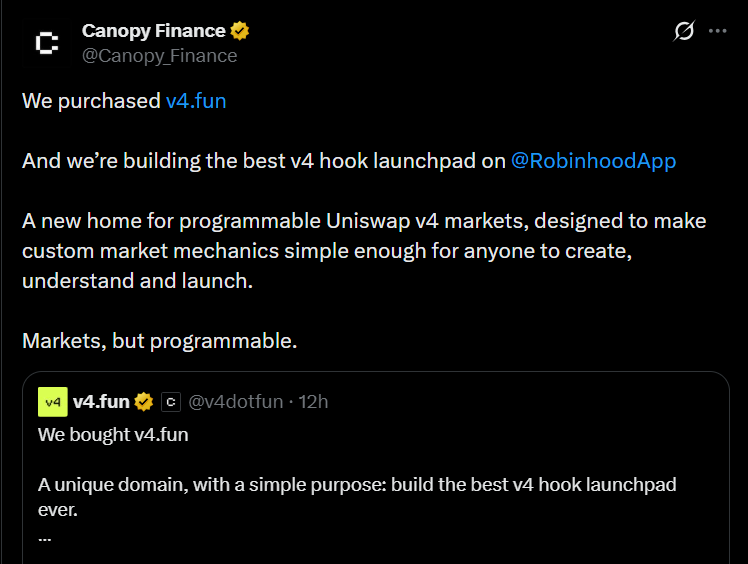
Source: Canopy Finance's Article
The following points come directly from the official v4.fun account or website.
- v4.fun is described as a v4 hook launchpad.
- The project is presented as being built by Canopy Finance.
- The stated objective is to make markets programmable.
- The announcement says every token launches into the same market.
- The announcement says the same fees and mechanics apply within that framework.
- The announcement gives a public launch time of August 25, 2026, at 20:00 UTC.
What should creators verify before launching a market?
Creators should treat the launch interface as a starting point for technical and economic due diligence, not as a substitute for it. Before signing a deployment transaction, verify the following:
- Which blockchain and Uniswap v4 deployment the market uses.
- Which contracts are deployed, including the token, hook, pool, and any supporting contracts.
- What permissions the hook has and which lifecycle functions it can call.
- How fees are calculated, who receives them, and whether they can change.
- Whether the contracts have been independently audited and whether the audit covers the deployed bytecode.
- Whether liquidity, treasury, ownership, upgradeability, or administrative controls exist.
- Whether the launch interface shows the exact transaction data and contract addresses before signing.
What should traders verify before using a v4.fun market?
Traders should verify the contract addresses, pool, hook permissions, fees, and liquidity before swapping. A programmable market can contain more logic than a standard token-and-pool launch, so a familiar interface does not remove smart-contract risk.
- Open the official v4.fun link rather than a copied or sponsored search result.
- Confirm the network and contract addresses before approving a transaction.
- Read the displayed fee and price-impact information.
- Check whether the token contract or hook has ownership or upgrade controls.
- Do not interpret launch timing, AI branding, or social-media engagement as evidence of value or safety.
- Never share a seed phrase or private key with a launchpad, support account, or automated agent.
What is not yet confirmed about v4.fun?
The reviewed primary sources do not establish several details that readers may reasonably want to know. A responsible launch article should identify these gaps rather than fill them with assumptions.
| Topic | Status in the reviewed primary sources |
|---|---|
| Exact launchpad fee schedule | Not specified in the reviewed v4.fun announcement or landing-page text. |
| Supported chains | Not specified in the reviewed v4.fun public text. |
| Security audit | No audit claim was established by the reviewed sources. |
| Token or protocol economics | Not specified in the reviewed v4.fun public text. |
| Exact hook library or menu | Not specified in the reviewed v4.fun public text. |
| Liquidity-locking or graduation rules | Not specified in the reviewed v4.fun public text. |
Why could v4.fun matter for Uniswap v4?
If the stated model works as described, v4.fun could make custom pool behavior more accessible to creators who do not write Solidity themselves. That would fit the broader design space of Uniswap v4, where hooks allow developers to attach custom logic to pools and implement selected actions around initialization, liquidity, swaps, and donations.
The broader significance is not that every launch becomes better automatically. It is that a launchpad can package a more flexible smart-contract primitive into a creator-facing workflow. The quality of that model will depend on implementation transparency, testing, contract review, fee clarity, and how much control creators and users retain after deployment.
Frequently Asked Questions (FAQs)
Q: What is v4.fun?
A: v4.fun is presented by its official account as a programmable-market launchpad built around Uniswap v4 hooks and powered by Canopy Finance.
Q: When is v4.fun launching?
A: The official v4.fun announcement states that the public launch is scheduled for August 25, 2026, at 20:00 UTC. Readers should check the official site for the current live status.
Q: Is v4.fun an official Uniswap product?
A: The reviewed sources describe v4.fun as a Canopy Finance project built around Uniswap v4 technology. They do not establish that v4.fun is operated, endorsed, or maintained by Uniswap Labs.
Q: What are Uniswap v4 hooks?
A: Hooks are external smart contracts that can be attached to Uniswap v4 pools to customize behavior at defined lifecycle points, including initialization, liquidity changes, swaps, and donations.
Q: Does AI make a v4.fun market safe?
A: No. AI-assisted generation does not by itself prove that a hook or token is secure, audited, profitable, or free from exploitable logic. Users should review contract and market information before interacting.
Q: Does v4.fun require creators to write Solidity?
A: The official v4.fun profile describes the product as enabling programmable markets without writing Solidity. The exact creator workflow and technical limits should be confirmed in the live product documentation.
Disclaimer: This article is for informational purposes only and is not financial, legal, or technical-security advice. Programmable smart contracts and digital assets involve substantial risk, including loss of funds. Verify official links, contract addresses, permissions, fees, audits, and network details before interacting with any market.